JSONPath Syntax Explained for Beginners
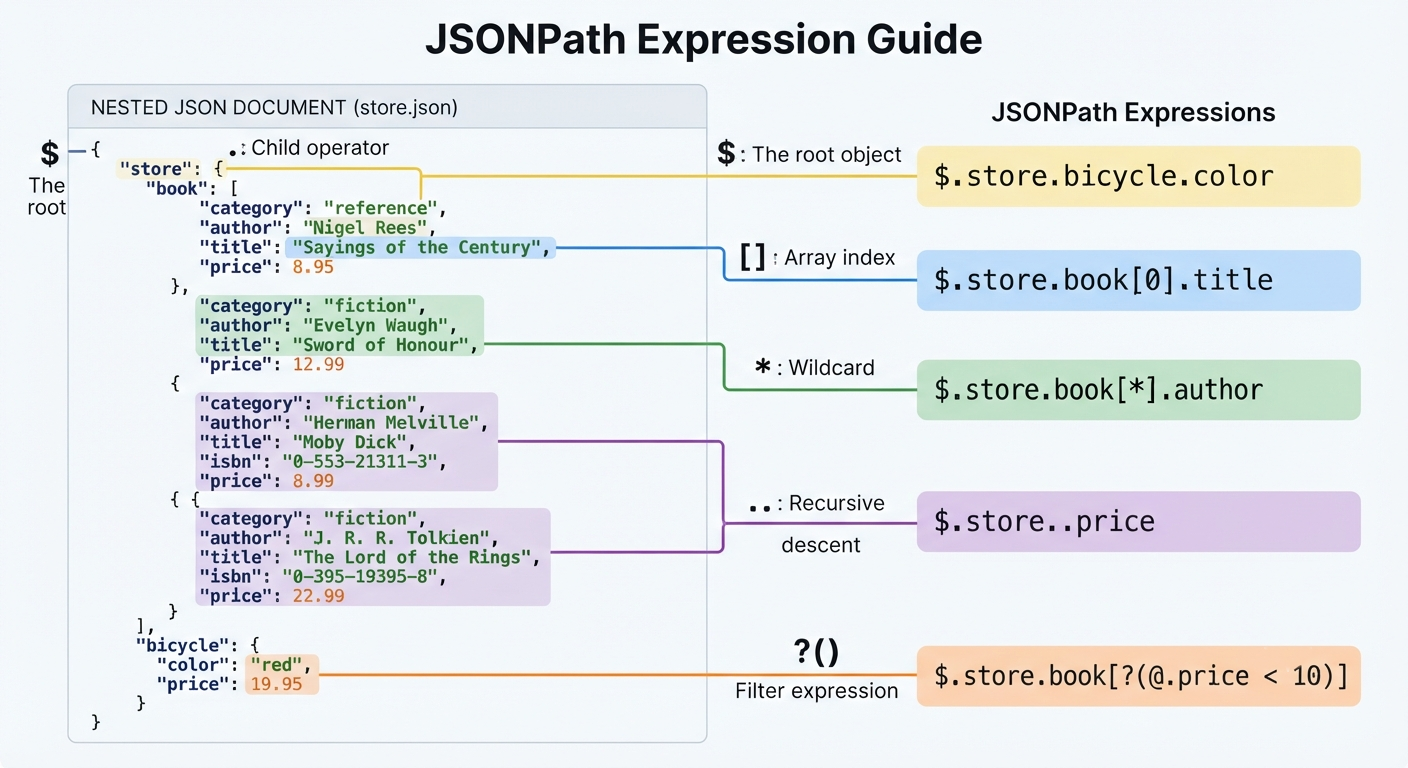
Working with JSON data is common in APIs, configuration files, web applications, and automation scripts. Finding a specific value inside a deeply nested JSON document can quickly become difficult if you don't know the correct path.
That's where JSONPath syntax becomes useful.
JSONPath is a query language for JSON documents. It allows you to navigate through objects and arrays using concise expressions instead of manually searching through the entire structure.
In this guide, you'll learn:
- What JSONPath is
- How JSONPath syntax works
- The meaning of common operators
- Practical beginner and advanced examples
- Common mistakes to avoid
- Best practices for writing readable JSONPath expressions
- When using a JSONPath evaluator like JSON Path Finder on codenimbletools can make testing expressions easier
JSONPath Syntax Explained for Beginners
What Is JSONPath?
JSONPath is a syntax used to select data from JSON documents.
Think of it as being similar to XPath for XML. Instead of navigating XML nodes, JSONPath helps you locate values inside JSON objects and arrays.
Consider this JSON document:
{
  "store": {
    "book": [
      {
        "title": "Clean Code",
        "author": "Robert C. Martin",
        "price": 35
      },
      {
        "title": "JavaScript: The Good Parts",
        "author": "Douglas Crockford",
        "price": 25
      }
    ],
    "bicycle": {
      "color": "red",
      "price": 199
    }
  }
}
Rather than manually traversing each object, JSONPath lets you write expressions that retrieve exactly what you need.
Why Learn JSONPath?
JSONPath is useful whenever you work with structured JSON data.
Common use cases include:
- Testing REST APIs
- Parsing API responses
- Automation workflows
- Data transformation
- Configuration files
- Web development
- Backend services
- Data extraction scripts
Many API testing and development tools support JSONPath expressions for extracting values from responses.
Basic Structure of a JSONPath Expression
Every JSONPath expression starts from the root object.
The root is represented by:
$For example:
$means:
Start at the root of the JSON document.
Accessing Object Properties
Use dot notation to access properties.
Example:
$.storeResult:
{
  "book": [...],
  "bicycle": {...}
}
To retrieve the bicycle object:
$.store.bicycleResult:
{
  "color": "red",
  "price": 199
}
Accessing Nested Values
JSONPath allows you to continue drilling down.
Retrieve the bicycle color:
$.store.bicycle.colorOutput:
redThis is one of the most common JSONPath expressions.
Working with Arrays
Arrays use square brackets.
Retrieve the first book:
$.store.book[0]Output:
{
  "title": "Clean Code",
  "author": "Robert C. Martin",
  "price": 35
}
Retrieve the second book title:
$.store.book[1].titleOutput:
JavaScript: The Good PartsRemember that array indexes begin at 0.
Using Wildcards
The wildcard operator (*) selects every matching item.
Example:
$.store.book[*]Returns every book.
Retrieve every title:
$.store.book[*].titleOutput:
[
  "Clean Code",
  "JavaScript: The Good Parts"
]
Wildcards are especially useful when you don't know how many objects an array contains.
Recursive Descent
The recursive descent operator (..) searches for matching properties anywhere below the current level.
Example:
$..priceOutput:
[
  35,
  25,
  199
]
Instead of specifying each object's location, JSONPath searches the document recursively for every property named price.
Selecting Multiple Properties
You can retrieve several array elements at once.
Example:
$.store.book[0,1]Result:
[
  {
    "title": "Clean Code",
    "author": "Robert C. Martin",
    "price": 35
  },
  {
    "title": "JavaScript: The Good Parts",
    "author": "Douglas Crockford",
    "price": 25
  }
]
This is useful when you need specific entries rather than the entire array.
Array Slices
Some JSONPath implementations support slice notation.
Example:
$.store.book[0:2]This returns the first two books.
Keep in mind that support for slice syntax depends on the JSONPath implementation you are using, so verify behavior if you're working across different tools or programming libraries.
Filter Expressions
Filters allow you to select array elements based on conditions.
Example:
$.store.book[?(@.price < 30)]Output:
[
  {
    "title": "JavaScript: The Good Parts",
    "author": "Douglas Crockford",
    "price": 25
  }
]
Here:
?()indicates a filter.@refers to the current array item.- Only books with a price less than 30 are returned.
Filters are one of the most powerful parts of JSONPath because they let you retrieve data based on values instead of positions.
Common JSONPath Operators
| Operator | Purpose | Example |
|---|---|---|
$ | Root object | $ |
. | Child property | $.store.book |
[] | Array index | book[0] |
* | Wildcard | book[*] |
.. | Recursive search | $..price |
?() | Filter | [?(@.price<30)] |
Learning these operators covers the majority of JSONPath expressions you'll encounter in everyday development.
Common Beginner Mistakes
Many beginners run into similar issues when writing JSONPath expressions.
Forgetting the Root Symbol
Incorrect:
store.bookCorrect:
$.store.bookUsing the Wrong Array Index
Arrays start at zero.
Correct:
book[0]Not:
book[1]if you want the first item.
Mixing Dot and Bracket Notation Incorrectly
Both styles can work, but be consistent and use the one that best fits your property names.
For example:
$.store.book[0].titleis easier to read than unnecessarily switching between notations.
Best Practices for Writing JSONPath Expressions
Writing valid JSONPath expressions is only part of the process. Following a few best practices can make your queries easier to understand and maintain.
- Keep expressions as simple as possible.
- Use recursive descent only when necessary.
- Avoid overly complex filters if a direct path works.
- Test expressions against sample JSON before using them in production.
- Verify compatibility when moving between different JSONPath implementations.
- Add comments in your project documentation explaining complex queries when appropriate.
One of the easiest ways to validate your expressions is to use a JSONPath evaluator before integrating them into your application. A tool like JSON Path Finder on codenimbletools lets you experiment with different JSONPath expressions using sample JSON, making it easier to confirm that your query returns the expected data before using it in your code.
Advanced JSONPath Examples
Once you're comfortable with the basics, you can combine multiple operators to create more powerful queries.
Find Every Author
To retrieve every author from the book array:
$.store.book[*].authorOutput:
[
  "Robert C. Martin",
  "Douglas Crockford"
]
Find Books Above a Certain Price
Filter expressions can compare numeric values.
$.store.book[?(@.price > 30)]Output:
[
  {
    "title": "Clean Code",
    "author": "Robert C. Martin",
    "price": 35
  }
]
Retrieve Every Title Anywhere in the Document
Using recursive descent:
$..titleOutput:
[
  "Clean Code",
  "JavaScript: The Good Parts"
]
This approach is useful when the JSON structure changes or contains multiple nested objects with the same property name.
Real-World Use Case
Imagine you're testing an e-commerce API that returns hundreds of products.
Instead of manually searching the response, you can use JSONPath to retrieve only the information you need.
Example response:
{
  "products": [
    {
      "id": 101,
      "name": "Laptop",
      "price": 899,
      "available": true
    },
    {
      "id": 102,
      "name": "Keyboard",
      "price": 49,
      "available": false
    }
  ]
}
Retrieve every product name:
$.products[*].nameRetrieve only available products:
$.products[?(@.available==true)]Retrieve every price:
$.products[*].priceThese queries can save time when validating API responses, building automation workflows, or extracting specific data from large JSON documents.
Benefits of Using JSONPath
Learning JSONPath offers several practical advantages.
- Quickly locate values inside complex JSON structures.
- Reduce manual searching through nested objects.
- Simplify API testing and debugging.
- Improve automation scripts that process JSON responses.
- Make data extraction more readable and maintainable.
- Work efficiently with configuration files and structured datasets.
Whether you're a beginner or an experienced developer, understanding JSONPath makes working with JSON significantly easier.
Limitations of JSONPath
Although JSONPath is powerful, it's important to understand its limitations.
- Not every implementation supports the exact same syntax.
- Some libraries support advanced filters while others do not.
- Slice notation and functions may behave differently depending on the tool.
- JSONPath retrieves data but does not modify JSON documents.
When working across multiple programming languages or frameworks, it's a good idea to verify that your JSONPath expressions behave as expected.
How to Use JSON Path Finder
If you're learning JSONPath or debugging an expression, a JSONPath evaluator can help you validate your queries before using them in your project.
JSON Path Finder on codenimbletools provides a convenient way to experiment with JSONPath expressions.
A general workflow looks like this:
- Open JSON Path Finder on codenimbletools.
- Paste your JSON document into the tool.
- Enter the JSONPath expression you want to evaluate.
- Review the returned values.
- Adjust your expression until it selects exactly the data you need.
- Copy the working expression into your application, script, or API test.
Testing expressions beforehand helps reduce errors and gives you confidence that your query targets the correct data.
Tips for Writing Better JSONPath Expressions
A few simple habits can make your expressions easier to maintain.
Start Simple
Write a basic path first before adding filters or recursive operators.
Avoid Unnecessary Recursive Searches
Recursive descent (..) is useful but can return more results than expected in large documents.
Keep Queries Readable
If a direct path exists, prefer it over a complex filter.
Test with Sample Data
Before using an expression in production, validate it against representative JSON.
Know Your Implementation
Different JSONPath libraries may support different features. Check compatibility if your query doesn't behave as expected.
Conclusion
Understanding JSONPath syntax makes it much easier to work with JSON data in APIs, applications, automation scripts, and configuration files. By learning the core operators, practicing with real examples, and following best practices, you can write clear and reliable JSONPath expressions for a wide range of tasks.
As you experiment with more complex JSON structures, validating your queries becomes increasingly important. A JSONPath evaluator like JSON Path Finder on codenimbletools provides a practical way to test expressions against sample JSON before using them in your projects.
Whether you're just getting started or refining existing queries, practicing with a dedicated evaluator is one of the easiest ways to build confidence and improve accuracy.